Monday, May 18, 2009

Iruvar- Part 1


I had for long wanted to write about this magnum opus , the first and last of its kind . I have never seen a movie portraying politics or rift between the thickest of friends so subtly yet effectively.
Brilliance of the maker is evident in every single frame of it. Technically superlative, the film benefits immensely from a very powerful characterization of the protagonists. It would be unfair to write a review as it is more of an experience which perturbs the viewer for a long time after the film ends. Hence I would like to express my thoughts on several scenes of the film which made a huge impact on me .

Scene 1- Madipukuriya ediriya illa pasathukuriya nanbara
An interesting friendship is flagged off the very first time Anandan and Tamizhselvam meet . This single scene succeeds in etching the contrast in the characters so strongly in our minds. On one side is a God fearing actor struggling to get a break to earn his bread while on the other end is a Tamil fanatic with strong sense of atheistic thoughts and disregard for God. This scene portrays the desire in Anandan to make it big and the faith and confidence Selvam has on his language and beliefs. However the highlight is the begining of the scene where Anandan sits on the throne hesitantly in the begining and shows an air once he is seated. The music changes pace from a slow trumphet solo to a heavy orchestration which adds to the intended symbolism on the future of the actor.

Scene 2- Ellathayum Maathuven
A scene involving the two lead characters discussing their theories of the changes either of them will bring about in the soceity if bestowed with the power. The discussion takes place on the terrace of a magnificient old palace which marks the regular meeting place of the two . This structure in the latter part of the movie gets portrayed as a symbol of their friendship. It starts off by a casual question which Anandan asks Selvam about his dreams of a changed soceity. Initially hesitant to reply, Selvam gets aroused after he is put forth the question repeatedly. This moment of arousal is powerfully expressed thanks to the heavy beats which start to play in the background. Selvam instantly expresses his desire in bringing about a Tamizh soceity where minorities come to power and where the rich and upper class people are thrown out. He gets lost in his dreams as he continues and gets interrupted when Anandan says that basically poverty and hunger should be eradicated. This reinforces the contrast in ideologies and thoughts of the two, but this time politically. Though Anandan barely says more than a sentence or two about what he would like to change, the earnesty in his voice speaks volumes about his political and social priorities which cater to the common man.

Scene3 - Naan verum nadigan daane!
It is ironical that it was Selvam who had actually sown the seeds of political desire in Anandan . Of course, it had an inner intention of exploiting Anandan's popularity for their party to benefit. Selvam forces Anandan off his meal and takes him to the terrace. Anandan slowly walks towards one corner to see what s in store. He is taken aback when he finds a huge crowd of people gathered down to catch a glimpse of him. He is puzzled and asks Selvam why he , being just an actor,enjoys so much of a following. . Selvam makes Anandan realize his popularity and hints at exploiting it to the needs of the party. He also uses the reference of Karl Marx and Lenin to emphasize. Anandan feels nervous to react to the public at first, but once Selvam catches hold of his hand and lifts it,he looses his apprehension and gets confident. As a consequence, he throws his shawl at the people which marks the birth of his realization about the significant place he holds in the people' heart. Not as just an actor, but as an icon!
The camera makes an amazing transition from the blankness of the terrace as the crowd slowly come into the frame once Anandan reaches the edge. This crane shot combined with Rahman's soulful humming as the crowd comes into picture produces goosebumps. The shot of Anandan and Selvam facing each other with the people seen in between can be considered as the best in the history of Indian cinema.

To be continued...


Tuesday, July 1, 2008

Wake up directors, its time to write!!

A worrisome discrimination between commercial and parallel cinema exists constantly in Kollywood. Even matured critics have got themselves entangled in the confusion as to which genre is generally more appealing and successful in terms of critical acclamation as well as box office success. However, now the situation is changing(for the better) and the haziness is getting cleared up as there seems to be no such apparent bifurcation amongst the current tamil films.Its been realised that ,films which have blended interesting commercial aspects with a genuine and solid script and characterisation have worked wonders in recent times. Sadly, only the critics (and not all directors) seem to have realised this as there are only a handful of such meaningful and sensible films . Films lacking in solid content which have sheer gloss and irrelavent commercial aspects are aplenty and continue to dominate in numbers. Though this infuriates me on one side on the shamelessness of the makers, it equally makes me sympathise with them for refusing to come out from the darkness they are in .

Lets recollect a few films in the last couple of years which are memorable, not due to their commercial success alone, but also because of the interesting content and substance value. The conclusions I am going to make from these could have been easily made from the films of the past decades also. Just that I wanted to take up the current scenario and discuss the prospects.
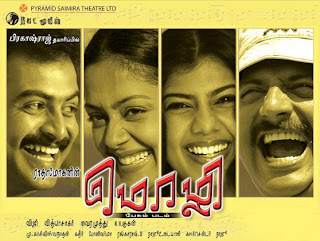


Mozhi- This is one of my favourites in recent times. A beautifully and poetically narrated film which had a serious theme about the attitude of a physically challenged lady. On paper,it is indeed a grave subject without any apparent room for "commerial aspects" like humour, romance, dream song sequences etc .Surprisingly it had its relavent share of all these. However, thse factors only enhanced the film and never tried to stand out odd or hinder the main storyline. Every aspect of the film like music, comedy gelled so well with the story that they were like gems studded on a necklace. I could nt but only thoroughly enjoy every moment of watching the film.
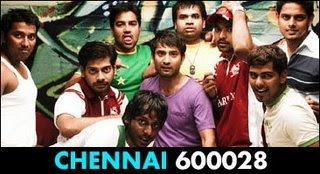


Chennai 28 - Another refreshing movie which had a never before dealt subject-gully cricket. Most of the faces were fresh and the director was a debutante. But this in no way afftected the wide reach of the film. In fact the movie ended up becoming the talk of the town despite the poor opening. Though there were too many characters in the film, the characterisation was superbly effective and the humourous sequences were a part of the main story without the need for a separate comedy track. Like the previous mentioned film, the technical aspects succeeded in enhancing Ch-28 and and stayed obediently "behind" the script.

Anjathey- This film was a big success though the "commercial aspects" were less in content. Thanks to the powerful characterisation and gripping screenplay. The main reason for its appeal can be attributed to the loyalty of all aspects of the film to the main story right from casting to music.

Analysing the success of the previous films, one thing becomes very clear. A film's success doesnt demand a powerful starcast or out of the world technical aspects costing a fortune . An engrossing screenplay along with the relavent commercial aspects and a good marketing strategy are enough to do the magic. Even a new comer can become a household name if he is true to his script and works hard on it.


I personally feel that this lack of a sensible script is the prime area where Sivaji failed. Though the film might have been a blockbuster,it is a milestone cinema neither for Shanker nor Rajini. The USP s of the film might have been the extraordinary technical aspects along with lavish sets, rocking music and of course ,Thalaivar :), but certainly not the story or the way the black money theme was dealt. This is why the movie can never be remembered for its content. Only the sensation over the budget and other superficial aspects stay in our minds still. However, Shanker was intelligent enough to make sure that he can completely bank on the magic name-Rajini...Same can be said of Dasavatharam. A blockbuster declared,its high point is the 10 roles and the 10 roles alone.Of course apart from the superior technical part of it.
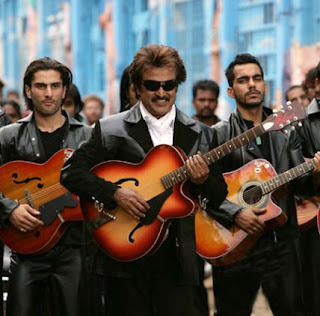


But Rajini and Kamal are two big forces in Kollywood who have the capability of single handedly bringing about the success of their films with their remarkable performance and their screen presence, irrespective of the story. This is especially true with Rajini. So ,by just considering one film of each, their case cant be blatantly equated to that of the one we are discussing now. They have given marvellous films in the past with strong storylines. We can just hope that they dont get carried away by the enormity of the success of their recent films both of which are weak story wise.

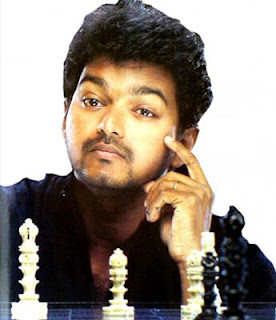
The actual culprits are people like Vijay who simply try to emulate others giving absolutely no consideration for the story. Eventually, this ends up in repeated failures. As is clearly evident from the latest 2 mega flops from ilayathalabadi(vidi). He is one actor(??) who doesnt bother to bring about a difference in his films.This is the case even with his costumes...leave alone the performance or story. He infact,once shamelessly told in an interview that he goes from the shoot of one film to another in the same attire. Admittedly,a graceful dancer, he gives plenty of importance to his dance movements in the songs. Had he taken even half of the same efforts in improving his histionic skills or choice of scripts, he could ve achieved reasonable heights as an 'actor'. But its useless talking about such an impossibilty as his refusal to change is apparent from the stills of his forthcoming film where he holds the same old porikki...err...Pokiri look..


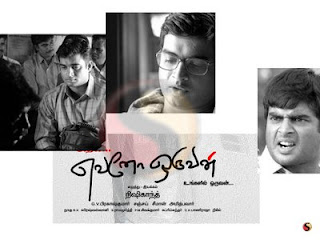
Now lets leave 'Mr. Do the same ' alone to dance and see why even meaningful films like Evano Oruvan have also failed in the recent times . This film did lack in masala stuff like songs/comedy and did bear a grave feel throughout. Nonetheless, it was gripping. The main reason might have been the poor marketing and wrong time of release. The film was running in the same cinema houses where the much hyped fashion show Billa was tasting great success. While releasing such an offbeat and lesser expected film along with an overly sensationalised flick , the distributors and the producer ought to have taken extra efforts to market the film effectively, which they failed at miserably. Thus,Evano Oruvan did remain true to its name.


From the above examples, it gets very clear that the script has to be the driving factor for any film to succeed.The converse is also true. If the script becomes the mainstay, the films success follows path automatically irrespective of the other superficial aspects like starcast, technology etc provided a wise marketing strategy is adopted. This not only helps the collections to reach the break even and go beyond, but also makes the film a memorable and widely acclaimed one. It stays in the minds of many for long, for the novelty and substance.


As someone rightly said ,a 'separate script writer culture 'can be adopted in Kollywood lifting a big burden from the directors head. Without having to take up all the work in his hands, the director can pay good attention to aspects other than the script , leaving the headache to someone else. However, such a turning point in Tamil Cinema seems nowhere at sight in the near future.


So,its high time directors start slogging over the script ( story, screenplay and characterisation including) trying to make it as novel and interesting as possible till they get it right. They can start thinking about other secondary matters like casting and scope for technology after this . However, they must constantly remind themselves of their responsibility to ensure that these secondary aspects including the "commercial aspects"are just servants who must stay faithful to their one and only master- THE SCRIPT!

Its time film makers give importance to us gaining value for our money than them valuing their gain.


Sunday, June 15, 2008

Movie Review - Dasavatharam


The History of Indian Cinema has proved on more than one occasion that a movie, however big the lead actor it has, however stunning his performance is, however superior the technical aspects are, can turn out into a damp squib and fail to impress ,if it lacks a solid content and story or at least a gripping and sensible screenplay. Dasavatharam is yet another occasion.

I don’t want to reveal the story here as I found nothing of its kind in the film.Initially, Kamal speaks promisingly about Chaos theory but the sequences are far from that. Parallel sequences run throughout in the film and clash with each other occasionally, mostly for the sake of it. But the incidents and the consequences are related mainly by the numerous coincidences which get too unappealing and illogical after a certain point. An example is the scene where scientist Kamal pleads with paati Kamal to get back the dangerous vial and the fight where CIA agent joins in. You feel that anytime Kamal could ve easily grabbed the vial from Paati Kamal or the idol from Asin to get back the vial given that Asin knows very well about the disastrous consequences. But things are unnecessarily complicated by childish acts and events leading to a frivolous handling, not only with the massively destructive vial, but also with the screenplay. The terrible thing is that such unappealing events driving the screenplay run throughout the film.


Kamal at his versatile best, stuns all with the remarkable difference he portrays in the 10 characters. Be it body language, make up or dialogue delivery, there is no way one could see a Kamal. In fact, in the most cases of the 10 characters, identification was a tough task. This itself speaks tonnes about the mighty prowess of the actor. The efforts and excertion he has undertaken is clearly evident in every frame of the film. There is no doubt that none other than Kamal can make such a task possible with such perfection.

The 12 th century flashback is a mentionable highlight. Kamal sends off sparks with his electrifying performance along with the strong support from razor sharp dialogues. But I didn’t find any significant link between this part and the rest of the story. Even a deep scrutiny will only find a vague and insignificant link in a couple of scenes. But this relation is no way to the main set of events leading to tsunami. Neither is it linked to the claimed employment of ‘Chaos theory’!! Even if it was supposed to be, it was not strongly conveyed!!

When the present set of events are flagged off with scientist Kamal working on bio weapons, the monkey death and chase of Kamal by Fletcher my expectations raised to that of an 'edge of a seat' entertainer. However after such a promising start, the film failed to hold on to my engrossment due to the absolute lack of (assistance from) script. Kamal seemingly had taken Chaos Theory as a premise and him playing 10 varied roles as a support for taking the liberty of making it a 'no story' affair. In fact it appeared as though the characters were listed before writing the script and sequences decided impromptu at the time of shoot.

Speaking of the characters, Rangarajan Nambi and Balram Naidu are my picks of the film. Balram Naidu excels in his humorously authentic dialogue delivery and mannerisms. As the CIA agent Fletcher who is in pursuit for the vial for mercenary reasons, Kamal sends a chill along your spine and speaks the American accent to perfection. Other characters worth a mention are the dark fellow and the tall Muslim guy in terms of make up and language. The Paati character, expected to be a very hilarious part in the film,disappoints totally and the over done make up only gives a feel of an alien creature! Though Bush character holds least weightage in the film and seems least wanted, the looks at certain angles are surprisingly close to the original. But the dialogues for the same lack sophistication. Japanese Kamal is splendid in looks and action.Awesome is the word!

But for the 12 century sequence, dialogues are another major drawback for the film. The entire set of scenes involving Kamal , Asin and the idol is an example. The supposedly subtle and hilarious dialogues hardly evoke any laughter and turn out into cheap 'Kadi' jokes which get you on your nerves especially in the second half. Even the funniest Balram Naidu, only depends on his body language cum accent, and not the dialogues to arouse any smile. The usual witticism and sensibility of Kamal are missing.

Asin succeeds in causing prolonged irritation and Mallika s role is least warranted in the film. The action scenes have been appreciably dealt in a painstaking manner.
Technically the film is very good with crystal clear camera work by Ravivarman and superb editing. Although special effects work wonders in scenes where more than one Kamals share the camera frame, they fail to be appealing in the Tsunami sequence.

As far as the music goes, Himesh s songs are already on top of the charts. However, the loud rerecording by Devi Sree Prasad falls harsh on the eardrums.

If we ponder about what actually went wrong in the film, we ll find that Kamal had concentrated overly (only) on his 10 roles taking the script for granted. Having taken the pretext of a complicated concept, the films screenplay merely revolves around a chase for the vial and scientist Kamal by a few others while rest of the Kamals are just present for bringing the number to 10. The unintentional meeting of few of them and how their lives are affected by that, have been hastily depicted probably because of the excess number of characters.

It remains hazy as to whether the film’s crux was God or to environment/humanity. In fact it is still not clear whether the movie had a message. However one thing which is very evident is that no concept was used in any part of the film given to the fact that absurd and childish set of sequences can’t be justified in the name of some scientific concept.

To sum it up, Dasavatharam can be watched once for the lone sake of ACTOR Kamal’s unimaginable efforts and matchless performance in the varied roles. However, the film as such fails to impress, leave alone meet the hype, courtesy an aimless script and needlessly complicated sequences....5.5/10

Tuesday, June 10, 2008

Mind matters - Different theories,same origin

I recently brushed through a magazine titled 'Frozen thoughts' which was lying in my house . Happened to get my eye on it as it was somewhere near the idiot box. It predominantly contained articles and experiences relating to philosophical thoughts, life and value of relationships. I didnt have the patience to read all that as the IPL finals was just half an hour away and my mind was already pre occupied with Doni ,Warne and many others. So I was restlessly flipping through the pages of lengthy paragraphs trying to get a glimpse of just the content,just when my eyes fell on a page full of terse sayings. I thought I ll settle with this and started giving a closer look.

It was a collection of quotes and maxims on meditation,sources including great thinkers and achivers from different epochs. The list ranged from Buddha to Bruce Lee, Richard Gere to Bhagavath Gita . The quotes employed different analogies and examples to portray the typical nature and behaviour of the mind and the meditation led approach to tackle it. The ride through the sayings was an interesting and thought provoking one.

When I was done ,I sat back and thought about what I had just gone through.I was taken aback by the realisation that the essence of all the quotes was one and the same albeit the different choice of words adopted in each. What startled me even more about the common-ness of the sayings was that the sources were completely unrelated in time . This drew me further towards their crux and bouldered my confidence on their verity. This was when I decided to mentally recapitulate the essential points of my just read wonderful quotes and my inferences from the same . Here they go...

The sayings did sound trite when they said that meditation is important for one to prevent thoughts from straying away and that one should sit in a quiet place with eyes closed and try to bring mind to a thoughtless state. However the excellent highlight was its emphasis on the fact that meditation is no activity which is carried out during a particular time. Meditation has to be intgrated in all our activities and after a certain point of time , meditation becomes life and fetches eternal bliss. For example, an activity as simple as sitting or walking becomes meditation if we bring in our full attention and consciousness to it. Meditation is not a state of rest, but a state of complete awareness and concentration on any object,physical or non physical. The endeavor of implementing meditation in our daily lives by pulling together all thoughts is a tought mental process due to the ever swaying nature of the mind. But this hardship and difficulty exists only in the initial stages. Because, once the meditated state is imbibed by the mind, it is ever lasting happiness which is going to prevail. Happiness totally independent of worldly issues. There lies no necessity of going in external pursuit of happiness. This eventually leads to mental peace,calmness and self realisation at a later stage which remains the ultimate aim of all .This is analogous to the case of muddy water where the water becomes clear when the mud settles down. Only thing is that we should remain patient till mud settles down completely . In the meditated state, the power of the mind reaches great scales and can be used to accomplish the most arduous of tasks and the right decision arises automatically and involuntarily in the most dilematic circumstances.

The principle of Karmayoga as emphasised in the Bhagavat Gheetha, postulates that one must focus on his/her duty without thinking about the end result. If one does that, fruitful results follow path eventually. Now lets compare this with the precept of meditation. Focus on our duty or task at hand is the same as centering all our thoughts to the activity we perform. And the undue worry and concern for the results is nothing but letting our thoughts wander away to things which are not in our control . This meandering of thoughts is what the art of meditation tries to put a barrier to. As beautifully claimed in Karmayoga, the unmindfulness about the upshot of a task will purify the mind off needless negative thoughts and will keep disappointment and sorrow out of the mindframe. This stunningly, is all about the eternal, lasting bliss dealt about by the preachers of meditation. As we travel back along the path of the two principles, we realise at a certain point that they converge to a common source and an unifying motive. ..That they are branches having grown from the same tree!!

The very realization of the convergence was overwhelming and produced goosebumps on me. It was a state of gratification ..but I very well knew that this was negligible when compared to the immense perpetual joy which can be derived out of practising them.

But the time I had recovered from this feeling, the Chennai Super Kings had lost their first wicket..joy was lost and tension resumed...